
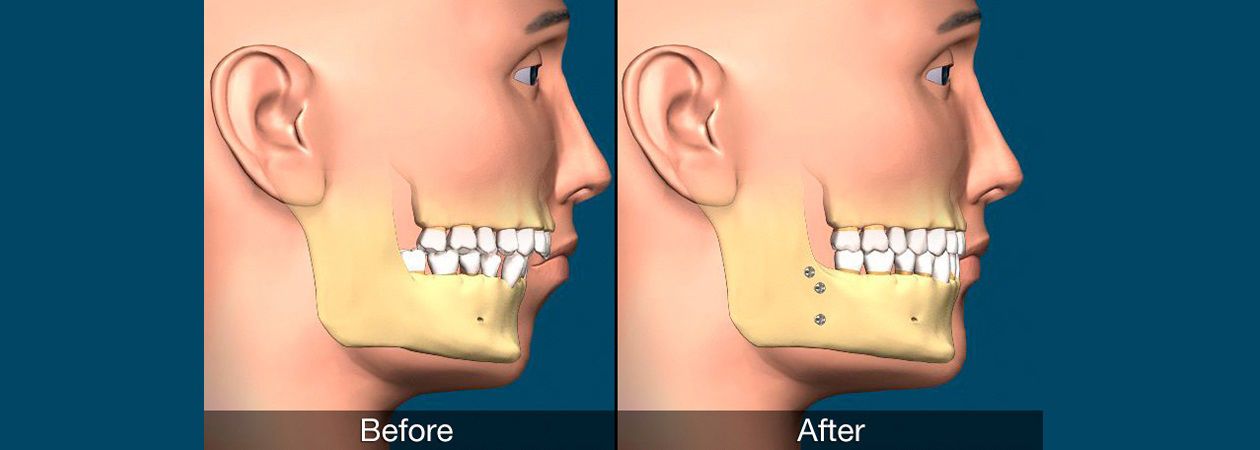
Orthognathic Surgery (Corrective Jaw Surgery) – Advanced Jaw & Facial Alignment Treatment in the UAE
What Is Orthognathic (Corrective Jaw) Surgery?
Orthognathic surgery is a specialised procedure that corrects jaw and facial bone irregularities to improve bite, facial symmetry, breathing, and overall function.
The word “orthognathic” comes from “ortho” (straighten) and “gnathos” (jaw).
This surgery realigns the upper jaw, lower jaw, or both — giving you a balanced facial appearance, improved chewing, and better oral health.
Why Orthognathic Surgery May Be Needed
Corrective jaw surgery is recommended when orthodontic treatment alone cannot fix complex skeletal problems such as:
✔ Class II Malocclusion (Overbite)
The lower jaw sits too far behind the upper jaw, causing difficulty biting, increased wear of teeth, and facial imbalance.
✔ Class III Malocclusion (Underbite)
The lower jaw is positioned ahead of the upper jaw, giving a prominent lower jaw and difficulty chewing.
✔ Open Bite / Deep Bite Issues
✔ Facial Asymmetry
Including uneven jaw growth or tilted chin.
✔ Functional Issues
Such as:
-
Difficulty chewing
-
Speech problems
-
Breathing issues (including snoring or sleep apnea)
-
TMJ pain
How Orthognathic Surgery Helps
Corrective jaw surgery can significantly improve:
✔ Facial Aesthetics & Symmetry
Corrects disproportions and creates a balanced profile.
✔ Bite Function
Allows upper and lower teeth to align for proper chewing.
✔ Breathing & Airway
Often improves sleep apnea and airway obstruction.
✔ Long-Term Oral Health
Prevents uneven tooth wear and future dental issues.
Treatment Process
1. Evaluation & Imaging
Detailed clinical exam, digital X-rays, CBCT scans, and photos.
2. Orthodontic Preparation (If Needed)
Braces/aligners may be required before surgery.
3. Surgical Correction
Performed under general anesthesia to reposition the jaw bones.
4. Recovery & Follow-Up
Most patients return to normal activities in 2–3 weeks.
Frequently Asked Questions About Orthognathic (Corrective Jaw) Surgery
Below are the most common questions patients ask before and after corrective jaw surgery.
This detailed FAQ helps you understand every stage of healing, comfort, eating, appearance, and recovery.
1. What should I expect with swelling after jaw surgery?
Swelling is normal and expected after orthognathic surgery.
It usually:
-
Peaks on days 3–5
-
Improves significantly after 2 weeks
-
Continues reducing gradually over several months
Your cheeks may feel tight or full, and some bruising may accompany swelling.
2. Why do I have bruising on my face, neck, or around my eyes?
Bruising occurs because jaw bones and surrounding tissues are repositioned.
Patterns vary:
-
Upper jaw surgery: bruising may reach the eyes (“black eyes”)
-
Lower jaw surgery: bruising may extend down the neck or chest
Bruising can take 2–3 weeks to completely fade.
3. Is nasal congestion normal after upper jaw surgery?
Yes. Nasal congestion is very common, especially with upper jaw (maxillary) surgery.
You may experience:
-
Stuffy or blocked nose
-
Thick mucus
-
Difficulty breathing through the nose
This improves within a few days, and decongestants may be prescribed.
4. Why do my ears feel blocked after surgery?
Blocked ears occur due to swelling around the Eustachian tubes.
Symptoms include:
-
Ear fullness
-
Muffled hearing
-
Pressure sensation
This typically resolves within 3–7 days, sometimes up to 2 weeks.
5. Why is my throat sore after jaw surgery?
A sore throat is usually caused by the anesthesia breathing tube.
It improves within 24–48 hours.
6. When can I drink fluids after surgery?
You can usually begin drinking fluids the day after surgery.
Once you are drinking comfortably, your IV line is removed.
7. What should I eat during the first few weeks?
Most patients follow a liquid or soft diet, such as:
-
Soups
-
Smoothies
-
Juices
-
Protein shakes
-
Puréed foods
Your appetite may be reduced initially — this is normal.
8. Why do I have difficulty talking after surgery?
Talking may be challenging due to:
-
Swelling
-
Numbness
-
Elastics or wiring
-
Sore throat
Your speech will improve gradually as healing begins.
9. Is drooling normal after corrective jaw surgery?
Yes. Drooling is common in the first week.
It occurs due to reduced lip control and swelling, and resolves as facial function returns.
10. How long will the numbness last?
Numbness is normal.
It may last:
-
A few weeks for upper jaw
-
Several weeks or months for lower jaw
-
Very rarely, it may be prolonged
Sensation improves as nerves heal.
11. What is the plastic splint in my mouth and why is it used?
A plastic bite splint may be placed to:
-
Guide your new bite
-
Stabilize your teeth
-
Support jaw position
It typically remains for 6 weeks.
12. Should I worry about nausea or vomiting after surgery?
Nausea is uncommon because:
-
Your stomach is empty before surgery
-
You receive anti-nausea medication routinely
If nausea occurs, remain calm. A suction device is available in the hospital.
13. How painful is orthognathic surgery?
Pain is usually moderate and controlled with medications.
Most discomfort improves significantly by day 5–7.
14. Is bleeding normal after jaw surgery?
Yes. You may notice:
-
Blood-stained saliva
-
Minor dripping from surgical sites
-
Slight nosebleeds after upper jaw surgery
This can continue for several days and is not a cause for concern.
Seek urgent care if bleeding:
-
Is heavy
-
Does not slow down
-
Comes from the nose continuously
15. Why does my appearance look alarming to family at first?
Early postoperative swelling may make your face look very different.
This is temporary and improves greatly within 1–2 weeks.
You may feel more swollen than you appear.
16. Why can’t I make normal facial expressions?
Swelling and numbness restrict expressions such as:
-
Smiling
-
Frowning
-
Lip movement
As healing progresses, full facial movement returns.
17. Why am I feeling sad or low after surgery (post-surgical blues)?
Mild depression around day 3–5 is common due to:
-
Steroid medication wearing off
-
Tiredness
-
Swelling
-
Temporary change in appearance
This mood change is normal and passes within a few days.
18. When will I start feeling like myself again?
Most patients begin to feel emotionally and physically better by day 4–7.
Energy improves as swelling decreases.
19. When can I resume normal communication?
Most patients can communicate clearly within a few days, though early speech may be unclear.
Rest your voice and avoid long conversations to prevent fatigue.
20. What if I experience nosebleeds after surgery?
Light, occasional nosebleeds are normal—especially after maxillary surgery.
They occur due to small mucosal tears.
Seek urgent care if:
-
Bleeding is heavy
-
Bleeding becomes continuous
-
You feel light-headed
21. How long will recovery take?
General healing timeline:
-
2–3 weeks: return to normal daily activities
-
3–6 months: complete bone healing
-
1–2 weeks: major swelling reduction
-
Full resolution of swelling: several months
